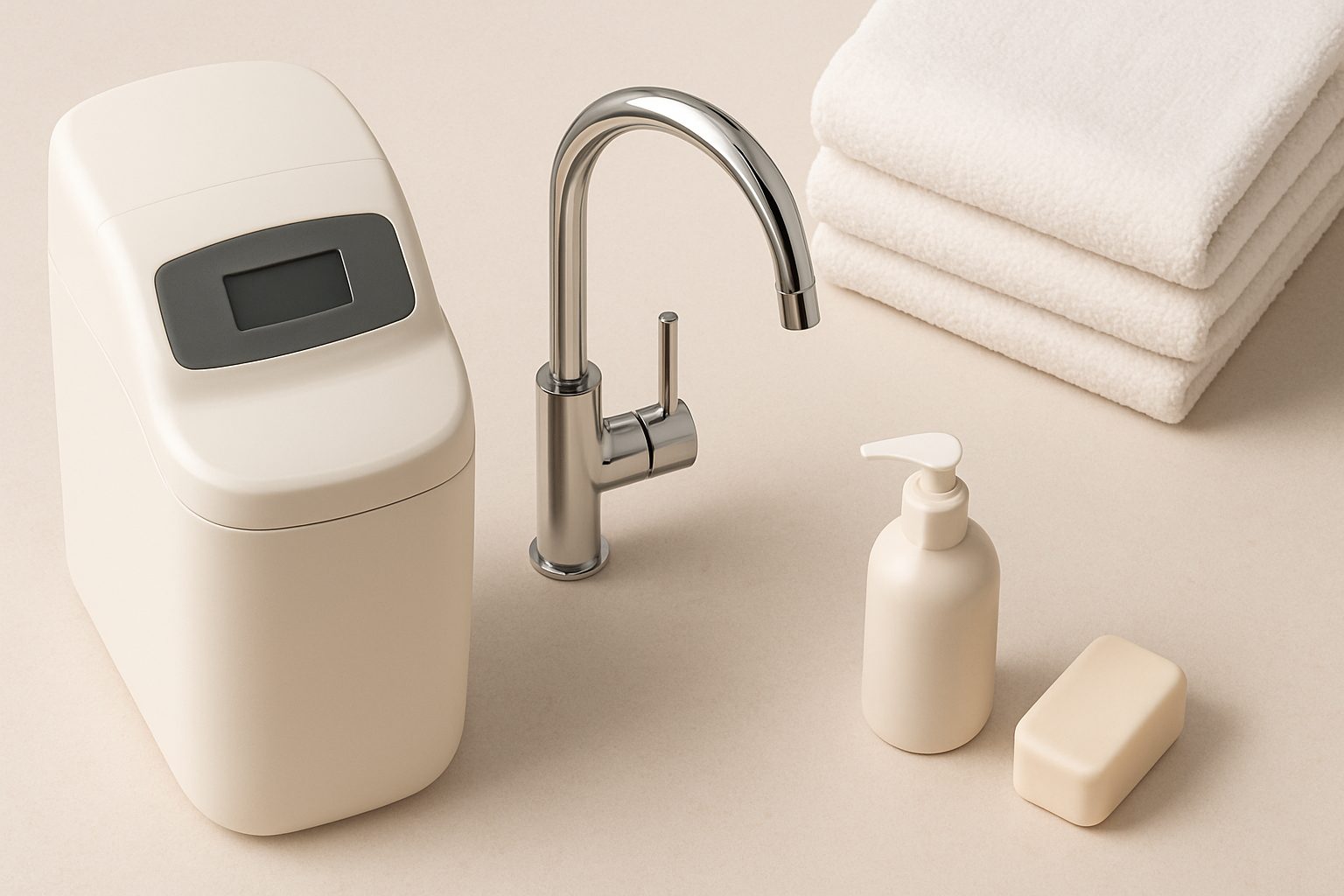
Best Compact Water Softeners UK 2025: Top Picks for Flats & Small Homes
If you live in a flat or small property with hard water, finding space for a traditional water softener isn't straightforward. Full-sized units need a dedicated utility room or cupboard—something most urban homes don't have. Compact and under-sink softeners solve this problem, though they come with trade-offs worth understanding before you invest.
Do You Actually Need a Water Softener?
Hard water affects roughly 60% of UK households, but it's not automatically a problem. Scale buildup on taps and shower heads is annoying rather than dangerous. Where softening genuinely helps: if your kettle scales up in weeks, your boiler efficiency is dropping, or you're buying expensive shower head descalers regularly, a softener will pay for itself in reduced cleaning products and appliance longevity.
Flats specifically benefit because you're often stuck with whatever water quality the building receives. Unlike a house where you might eventually move, softening makes your daily routines easier immediately. The trade-off is salt storage and regular refilling—something to factor into cramped space decisions.
Under-Sink vs. Slimline: Understanding the Difference
Under-sink models fit beneath the kitchen sink, taking up cabinet space but using minimal wall room. These are smaller resin tanks that soften water on demand. You'll need to redirect a cold-water pipe from your main supply, which involves cutting into pipework—a plumber's job in most cases.
Slimline cabinet units sit against a wall or in a corner, typically in hallways or utility spaces. They're taller and narrower than standard softeners, around 40–50cm wide. They require floor space rather than under-sink installation, which can actually be easier for flat dwellers since there's no pipework disruption.
The key limitation of compact units: they soften less water per cycle than large softeners. If your household uses significant hot water (long showers, frequent laundry), you might notice the resin becoming exhausted mid-week, reducing soft water availability. Larger families in houses rarely face this; smaller households and couples in flats usually don't either.
Harvey BWT Mini
The Harvey BWT Mini is compact by necessity—it's genuinely small, fitting under most sinks without removing pipes. It uses point-of-use softening, meaning it conditions water as you draw it, rather than supplying your whole home. This limits it to kitchen use, though that's often where you notice hard water most: in boiling kettles and washing fruit.
Pros:
- Minimal installation disruption
- Takes almost no space
- Low salt consumption relative to capacity
- Suitable for renters with restrictions on alterations
Cons:
- Doesn't soften water throughout the home
- Resin capacity is roughly 5,000 litres before regeneration
- You'll still see scale on bathroom taps
- Requires annual cartridge replacement
For someone in a one-bedroom flat who just wants soft water for the kitchen, this works. For households where hard water affects showers and washing, it's only a partial solution.
Aquatec Compact
Aquatec's compact range targets the middle ground—larger than under-sink units but narrower than full-size softeners. Around 45cm wide and 1.2m tall, they fit into tight corners while offering reasonable capacity (typically 10,000–15,000 litre cycles).
Pros:
- Whole-home softening (not point-of-use)
- Better resin capacity than under-sink models
- Fits flats without dominating the space
- Similar salt costs to larger units, pro-rata
- Easier installation than some under-sink systems
Cons:
- Requires a water supply connection and drainage outlet
- Takes up floor space, limiting hallway or corner usage
- Still smaller capacity than family-sized softeners
- Regular salt top-ups (monthly for 2–3 person households)
These work well for flat dwellers who've already committed to softening and can accommodate a corner unit. Not ideal if every square centimetre matters.
Capacity and Regeneration: What You Need to Know
Compact softeners regenerate (recharge their resin) based on how much water you've softened, not on a timer. This is actually an advantage—you're not regenerating on schedule if you're away, wasting salt and water.
However, if you have a high-capacity week (visitors, extra laundry), a compact unit might exhaust mid-week. You'll get hard water again until regeneration completes overnight. Full-time households average 150–200 litres daily; compact units typically manage 10,000–15,000 litres before regeneration, which translates to 50–100 days of use. Tight, but workable for smaller homes.
Installation Reality
Under-sink models need professional plumbing if you're not confident cutting into pipes—costs typically £150–300. Slimline cabinets need a water supply and drain connection; if neither exists nearby, you're extending pipework, which complicates installation further. Both require electricity for the control valve.
Flats add constraints: you might need landlord permission, and routing drainage to the nearest outlet (often far from where space exists) can be expensive. Budget for professional installation; DIY risks water damage.
Salt and Maintenance
All softeners use salt blocks or tablets for regeneration. Compact units use slightly less than large softeners but still require monthly top-ups for typical households. You'll store 25–50kg of salt somewhere—under the sink, in a corner, or a cupboard. It's not optional, and it adds a maintenance overhead you don't have with hard water.
Should You Buy One?
Compact softeners make sense if:
- You're in a flat with confirmed hard water
- You can tolerate modest installation disruption or find a slimline unit
- You're willing to top up salt monthly
- You accept whole-home softening won't be unlimited capacity
They're poor choices if:
- Space is genuinely minimal (under 1m² available)
- You're renting and can't alter plumbing
- Your household uses extraordinary amounts of hot water
- You want a maintenance-free solution
For most flat dwellers in hard-water areas, a compact softener is practical. Just be realistic about space constraints and installation costs before ordering.
More options
- Amazon UK — Salt-Based Water Softeners (Amazon UK)
- Amazon UK — Salt-Free & Magnetic Water Conditioners (Amazon UK)
- Amazon UK — Water Softener Salt Blocks & Tablets (Amazon UK)
- Amazon UK — Water Hardness Test Kits (Amazon UK)
- Harvey Water Softeners & BWT UK — Brand Affiliate (Amazon UK)